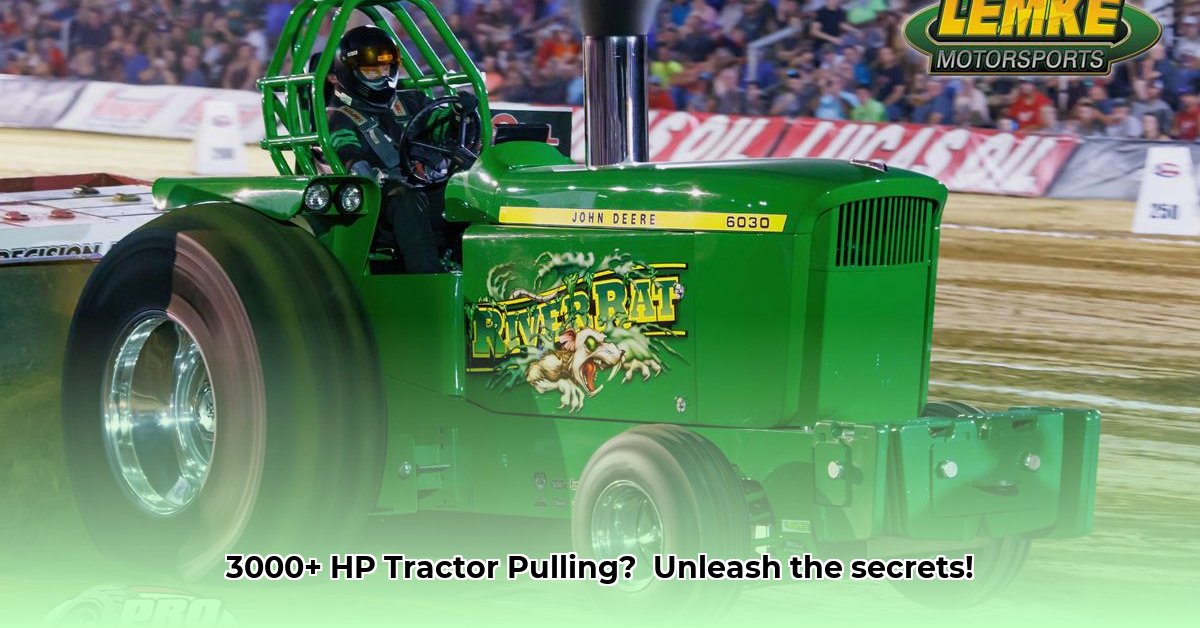
Tractor Pulling Pro Stock: 3000+ HP Machines: A Deep Dive
Pro Stock tractor pulling isn't your average farm chore; it's a spectacle of raw power where heavily modified tractors, spitting fire and earth, battle for supremacy. These aren't your grandfather's farm tractors; they are purpose-built behemoths generating over 3,000 horsepower – enough to make your head spin! This article delves into the engineering marvels, competitive strategies, and future trends of this thrilling sport. For more on the most powerful tractors, check out this helpful resource.
Unleashing the Beasts: Engine Power and Modifications
Imagine a machine producing over 3000 horsepower. That's the reality of Pro Stock tractor pulling. Most teams utilize inline-six cylinder engines, a reliable design, although Massey Ferguson's success with V8s proves there's no single optimal configuration. Engine displacements often reach 680 cubic inches (a substantial volume).
To achieve such power, extensive modifications are crucial. Massive turbochargers, some with compressor wheels exceeding 130mm, force air into the combustion chambers at pressures exceeding 100 psi. This extreme boost creates intense heat, necessitating sophisticated water injection systems (which cool the air and increase its density for greater power). Precision fuel injection systems, such as the Billet Sigma, precisely meter fuel for optimal combustion. It's not just brute force; it's about precise control and maximizing efficiency. Isn't it fascinating how much engineering is involved in seemingly simple agricultural machinery?
The Rules of the Game: Regulations and Innovation
While Pro Stock rules allow extensive customization, limitations ensure fairness. A key rule mandates that the engine block must originate from a standard, two-wheel-drive tractor. This restriction sparks incredible ingenuity, forcing builders to find innovative ways to boost performance while adhering to regulations. Even seemingly minor details, like injection pump mounting location, significantly impact allowed modifications, resulting in unique design solutions. This balance between freedom and regulation keeps the sport dynamic and exciting. How do you think these restrictions influence the competitive landscape?
Beyond the Engine: Chassis and Strategy
The engine is only half the battle. Weight distribution is paramount. Competitors meticulously distribute weight, often concealing it to lower the center of gravity and enhance traction – a high-stakes game of physics where every ounce counts. The chassis undergoes significant modifications to endure the immense stress and power. Roll cages, meeting stringent safety standards (like SFI Spec 47.1), are mandatory, protecting drivers from extreme forces. Even tire and hitch design contribute to pulling capacity. How much of a role do you think driver skill plays in optimizing the machine's performance?
The Aftermarket Ecosystem: The Supporting Cast
Pro Stock tractor pulling is supported by a robust aftermarket ecosystem. Specialized builders create and supply critical components, constantly pushing engineering boundaries. Tuning services meticulously fine-tune these machines, maximizing power output. It's a collaborative community where innovation is shared and refined, vital for the sport's continuous evolution. What impact does this collaborative environment have on the speed of technological innovation?
Future Trends: What's Next?
The future holds continued refinements of existing technologies and exploration of alternative cooling solutions and durable materials. Advancements in turbocharger designs and fuel systems promise even more power. Sophisticated data acquisition systems are becoming increasingly prevalent, allowing for precise performance optimization. Coupled with further chassis design advancements, this will likely lead to even more impressive pulling power. The future, therefore, is a relentless pursuit of greater power and dominance. What new materials or technologies do you think might disrupt the industry in the coming years?
A Competitive Landscape: The Players and Their Strategies
| Competitor/Team | Tractor Brand | Engine Configuration | Notable Strategy/Innovation |
|---|---|---|---|
| Team A | John Deere | Inline-6 | Advanced water injection system; sophisticated weight distribution |
| Team B | Massey Ferguson | V8 | Unique turbocharger configuration; custom-built fuel system |
| Team C | John Deere | Inline-6 | Focus on lightweight chassis design; innovative tire technology |
(Note: This table provides examples. Actual competitor names and strategies may vary.)
The world of Pro Stock tractor pulling is a captivating blend of brute force, precision engineering, and intense competition. The ongoing research and development within the field continue to push the limits of what's possible.
How to Optimize Water Injection Systems for Pro Stock Tractor Pulling
Key Takeaways:
- Water injection significantly boosts horsepower by cooling compressed air.
- Optimal injection placement (pre-turbo vs. crossover pipe) impacts performance and system complexity.
- Proper nozzle selection and atomization are crucial for effective cooling.
- Safety measures, including a pyrometer, are essential to prevent engine damage.
- Regulatory compliance varies; check competition rules.
- Cost-effective DIY options exist, alongside commercially available kits.
This section provides a detailed guide on optimizing water injection systems for enhanced performance. Specific strategies and considerations are presented to improve system implementation and efficiency. Remember that safety is paramount.